Regulatory guides, deal-structuring notes, and CSR perspectives from the team behind 100+ published contributions on Indian education strategy, market entry and policy.
Fox & Mandal × MAS Advisory, 2026
UGC branch campuses vs. GIFT City
Deals, structuring, CSR & regulation
Original market research and regulatory analysis from MAS Advisory and our research partners — the first rigorous sizing of the Indian open schooling market, and a practical guide to India's education deal-making landscape.
Prepared by WONK Open Schooling Research in partnership with MAS Advisory — the first rigorous, fully-sourced sizing of the global open schooling market and the Indian open schooling market, built bottom-up from NIOS's own data, Ministry of Education records, and Cambridge International's disclosed figures.
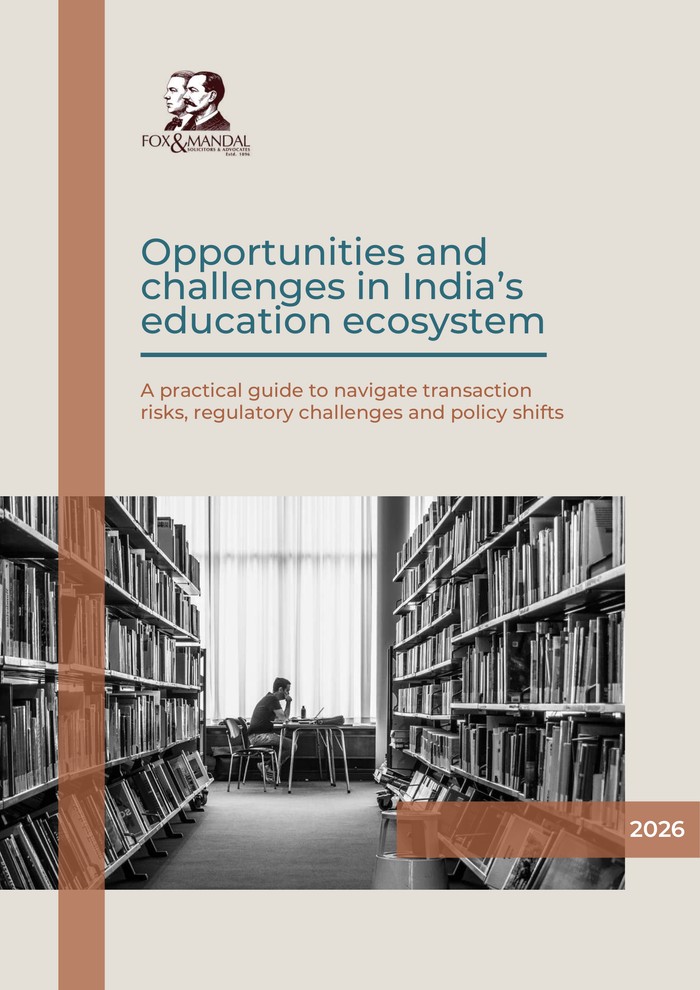
A joint publication with Fox & Mandal, Veale Wasbrough Vizards (UK) and the Ryan Group of Schools, covering India's regulatory architecture, the NEP 2020 and Viksit Bharat Shiksha Adhishthan Bill, GIFT City's IFSCA framework for foreign universities, and the deal structures foreign investors actually use to enter Indian education.
Confidential deal advisory mandates across healthcare, education infrastructure, and institutional land in India — a rare institutional land parcel in Central Delhi, hospitals for sale in Delhi NCR, CBSE school acquisitions, and a private university acquisition opportunity in Uttarakhand.
🟢 7 confidential mandates currently live — each represented directly by MAS Advisory, not resold through a broker network or listed on an open marketplace.
Long-form guides written to answer the questions we're actually asked in client conversations.
Search engines give confident, oversimplified answers to Indian education law. We find the real, documented exceptions — with names, numbers, and sources — and correct the record.
A Gurgaon school owner told a business newspaper in 2007 his school was "run like a company." In 2026, that same school — Pathways World School — was acquired for roughly ₹1,500 crore, still for-profit. Search engines still say Indian schools must be non-profits. Here's the real, board-specific rule.
Read the full story →Medical college ownership rules have reversed three times since 2017 — a court and a regulator currently disagree.
Read it →NIIT and Aptech run skill training as ordinary listed companies — the regulator's own mandate says for-profit is the goal.
Read it →Allen took a $600M investment at a $1.2B valuation as an ordinary company. No non-profit rule ever applied.
Read it →MCA's 2026 amendment lets companies route up to 10% of CSR spend through Social Stock Exchange ZCZP instruments. This series covers the rule, the diligence, and the reporting — in that order.
What changed on 27 May 2026, what a Social Stock Exchange and ZCZP instrument are, and how a company actually invests.
Read Part 1 →The impact-assessment exemption is a real relief and a real risk — what CSR Committees should verify before subscribing.
Read Part 2 →Board Report disclosure, Form CSR-2 filing, and where the guidance is still genuinely unsettled.
Read Part 3 →The first rigorous sizing of the global and Indian open schooling market — NIOS, State Open Schools, and Cambridge/Edexcel private candidature, in full.
Read the synopsis →How the UGC's 2023 branch-campus regulations and GIFT City's IFSCA framework actually work, who's eligible, and which route fits your institution.
Read the guide →Why you can't simply buy equity in an Indian school, and how the OpCo–PropCo–ManCo model lets investors participate legally and commercially.
Read the guide →Why education-focused CSR needs sector fluency a generalist CSR consultant won't have — and what good programme design looks like.
Read the guide →An overarching regulatory mechanism to facilitate the growth of digital learning, and the active role industry can play.
Read on masadvisory.in →Turning NEET online (like JEE, CAT), online proctoring and biometric checks to make testing more robust.
Read on masadvisory.in →A practical comparison for schools and universities — governance, credibility, and tax treatment under the Income Tax Act, 2025.
Read the guide →UGC, AICTE, NCVET and State board compliance explained — and how to tell a genuine regulatory consultant from a generalist.
Read the guide →What the Vitruvian/K12 Techno and KKR/Lighthouse Learning deals signal for school promoters and investors in 2026.
Read the analysis →The revised Form CSR-1 now gates who can legally receive CSR money — what schools, trusts and education NGOs need to check now.
Read the guide →Most costly mistakes happen months before the negotiating table — when a strategy question got skipped in the rush to find a target.
Read the guide →A bill to replace UGC, AICTE and NCTE with one regulator has cleared Cabinet and is now with a Joint Parliamentary Committee — what its current status means for structuring decisions today.
Read the guide →IFSCA approved revamped International Branch Campus Regulations on 24 July 2026 — permanent registration and other changes from the 2022 framework.
Read the guide →18-19 universities are approved. Four are operational. What their actual enrolment numbers say about the wave — and the financial-sustainability question that matters more.
Read the guide →There's no single published multiple for Indian education assets. What actually drives valuation — the PropCo/OpCo split, accounting treatment, and deal structure.
Read the guide →The UGC's new anti-discrimination rules were stayed by the Supreme Court in January 2026. What's actually in force on campus right now.
Read the guide →Harrow, Wellington and Shrewsbury have all licensed their name to Indian promoters. What the deal structure actually looks like — and what nobody discloses.
Read the guide →Investors compare hospital and school acquisitions as similar plays. The same PropCo/OpCo structure means something legally different in each sector.
Read the analysis →Education gets the largest share of India's CSR spend — ₹13,877 crore. Only 22% of all CSR funding reaches states that actually need it most.
Read the analysis →Institutional land is a legally defined, scarce category under Indian zoning law — not just real estate. What that means for education deal-making.
Read the analysis →Run for profit since 2007, acquired for ₹1,500 crore in 2026. Search engines still say Indian schools must be non-profits. Here's the real rule.
Read the analysis →Straight answers to the questions we hear most from schools, universities, investors and foundations.
We respond personally, and only when we believe we can be useful.